
Carbon Neutrality
There is no getting around it – travelling has a carbon cost. Whether that be flying to your initial destination – the aviation industry contributes to around 2.5% of global carbon emissions – or travelling between locations once we are there – rail travel emits 10 times less carbon than travelling by car – as responsible travellers, it is incumbent upon us to take this into consideration.
But you can’t do anything about it, unless you can measure it – and how do you do THAT?!!
The first thing to recognise (after recognising that there is a carbon cost to your vacation) is that what you do individually will have a tiny effect on climate change – but cumulatively, you AND me AND everyone travelling DO make a difference.
The next thing is – you don’t need to be a climate scientist to get a bit of basic understanding of what your impact is. As a traveller, (unless it is your thing) you should only think about your own immediate effect – using an electric bus rather than a diesel bus has to be taken at face value as a better choice, without a full information deep dive to find out what percentage of electricity in that location is produced by fossil fuels compared to renewables.
The Right Choice
With these points in mind, what can you do to reduce your carbon footprint? Simply put, just try to make the right choice. Avoid domestic flights if possible – don’t fly if you can take the train. If you can travel by train, consider doing this instead of by road. And if you have to travel by road, consider using buses rather than hiring a car, and use electric versions of vehicles when possible. In towns and cities, use public transport, cycle – or my favourite – just walk.
Do the things you do at home to help with the environment. Recycle where and when you can. Use showers rather than baths. Turn off lights when not in use. Try to keep heating and air conditioning to a minimum.
Measuring and Offsetting
This isn’t as hard as you might think. Without a doubt, your biggest environmental impact is your flight to your destination and your flight home. There are various online calculators for this, but one of the easiest to use is from the ICAO – a UN agency, so pretty accurate. Click the Passenger Calculator button (rather than the freight calculator) and put in your departure and destination, whether you are travelling economy or premium, and whether is is a round trip or one way.
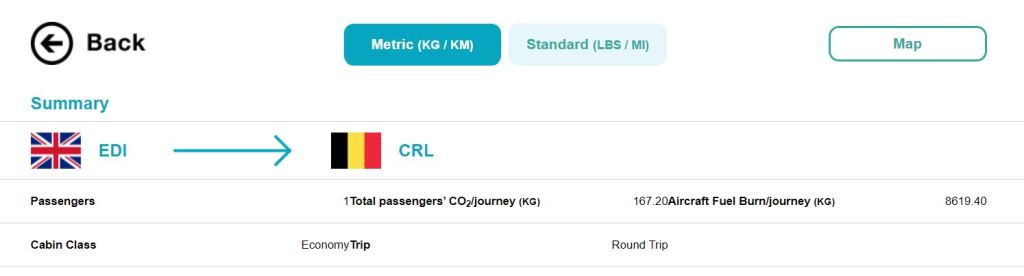
In this case, it shows that a return trip from Edinburgh to Charleroi for a single passenger using economy is 167.2 kg of carbon.
Another excellent online calculator, which can also be used to measure other modes of transport is from Carbon Footprint. This will allow you to measure all of your travel in one place – flights, buses, car hire, and trains.
And for all those other things, from sending emails to eating bananas, you could do no better than checking your carbon footprint in this excellent book – How Bad Are Bananas by Mike Berners-Lee.
So now you know how much your vacation is going to cost in carbon, you need to decide what to do about it. Some companies will allow you to add carbon offsetting when buying a ticket. This is normally a relatively small charge – between EUR 2 and EUR 5 – with some making a further contribution on your behalf. If you want to have a bit more control over this, you could consider contributing to an environmental charity, such as my favourite – Trees For Life.
A tree stores between 14kg and 46kg of carbon each year, depending on species, location, and other factors. A pine tree absorbs 14kg, a fir absorbs 20kg, whereas a Douglas fir absorbs 46kg. So, if you can measure your carbon footprint, and you know that a tree (on average) absorbs around 20kg of carbon each year, you can get an idea of how to offset your carbon footprint.
I like Trees For Life because they plant species native to the Caledonian forest in Scotland, including alder, aspen, birch, cherry, hazel, holly, oak, rowan, Scots pine, and willow. This also encourages native animal species and promotes biodiversity. You can set up your own grove where trees will be planted, or you could add to mine. Click here – JC Stephenson’s Caledonian Grove – and follow the instructions.
 Betravelled
Leave a comment